
.
Imagine being under the stage lights, your heart pounding in sync with the thrum of the band behind you. The crowd roars in anticipation, and there you are, cradling your faithful Telecaster as it hums with life against your chest. If you’re anything like me, your Telecaster isn’t just a guitar; it’s a companion. It’s honest, rugged, and at times, a bit stubborn. We’ve all heard the debates in the green rooms and the forums: Is it the swamp ash body? Is it the maple neck? Is it those magic pickups? As someone who spends hours lost in the twang and the growl of my own Tele, wearing that classic “ashtray” bridge, I’ve realised something fundamental. We often overlook the very thing holding everything together. We talk about the “wood” and the “wire,” but we forget the “plate.”
If you have a hard time focusing on technical specs (trust me, my brain also prefers a good riff over a spreadsheet), let’s simplify this. Think of it like the chassis of a car: it provides the necessary stability and structure, allowing everything else to function at its best. This was Leo Fender’s own term for that metal plate under your bridge pickup. It’s not just a part; it’s the secret sauce, the magnetic heart, and the structural anchor of the most recorded guitar in history.
To understand why the Telecaster bridge looks and sounds the way it does, we have to travel back to the late 1940s, specifically to 1950. This was the year when Mr Fender transitioned from crafting lap steels to focusing on what would soon become the Broadcaster. Leo wasn’t a “luthier” in the traditional sense. He didn’t spend years carving delicate violins or archtop jazz guitars. He was a radio repairman. He approached the guitar as an industrial problem to be solved efficiently.
Before the Telecaster (or the Broadcaster, as it was first known), Leo was making lap steels. Those are the horizontal guitars played with a metal bar. In a lap steel, everything is about directness and power. When he sat down to design a solid-body electric guitar, he didn’t want the complexity of the “fine” guitars made by companies like Gibson.
In a typical guitar of that era, you had a complicated mess of parts: a tailpiece to hold the strings at the bottom, a bridge to hold the strings up, and a plastic ring to hold the pickup in place. That’s three separate pieces of hardware, three different materials, and multiple points where energy and tone could be lost.
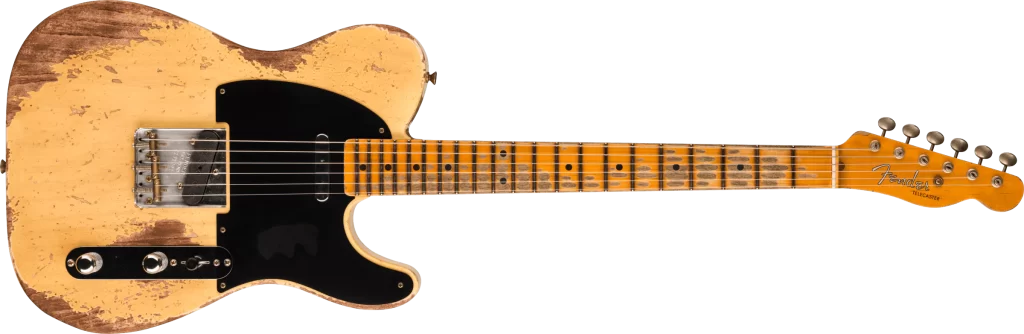
Photo: Getty Images
Mr. Fender looked at that and said, “Why?”
His solution was a stroke of brilliance; he designed one single piece of cold-rolled steel that would do all three jobs at once. It would hold the strings, set the height and intonation via the saddles, and house the pickup. If he hadn’t kept the three-part assembly like other guitars of that era, the Telecaster might have lacked its iconic ‘stiffness’ and ‘directness’, losing energy at multiple junctions. Instead, the single slab design allows the vibration to travel unimpeded into a massive piece of steel screwed directly into the body. This is why a Telecaster feels ‘stiff’ and ‘direct’ in the best way possible. It’s a unified system.
“Ashtray” vs. The Modern Standard
Before we dive into the physics of tone, let’s preview the two main types of Tele bridges: “ashtray” and modern standard. Knowing which bridge you’re dealing with will help make sense of the tonal differences. You’ve probably seen these different metal plates out there, and they play a crucial role in shaping the Telecaster’s unique sound.
1. The Vintage “Ashtray”
This is the bridge I swear by. It’s the one you see on the “Original 50s” models and vintage reissues. It’s called an “ashtray” because, back in the day, Fender shipped these guitars with a chrome metal cover. Leo thought the exposed pickup and saddles looked unfinished, almost like plumbing. He designed a beautiful chrome cover to hide it all.
However, guitarists immediately realised two things:
First, you couldn’t palm-mute the strings with the cover on.
Second, the cover made a perfect place to flick cigarette ashes during a gig.
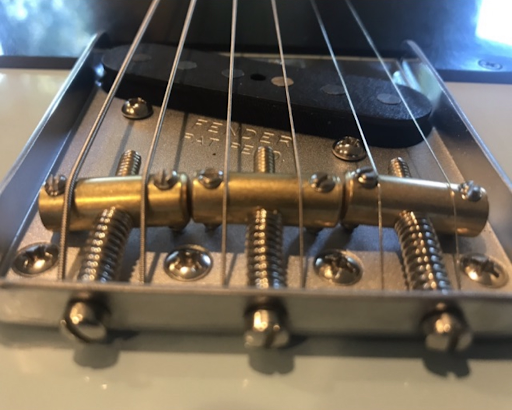
Photo: Getty Images
The name stuck, and even though we rarely use the covers today, the bridge with the high side walls is still called the “ashtray.” It usually features three saddles (one for every two strings) made of brass or steel. Imagine, back in those smoky dance halls and dimly lit venues, the scent of cigarette smoke curling over the chrome cover, mingling with the sweet notes of the guitar. It’s a snapshot of an era, where the look and feel of an instrument connected players to a time thicker than sound, a vivid memory embraced in metal and smoke.
2. The Modern/Standard
This is what you’ll find on the “American Standard” or “Player” series. It looks much more like a Stratocaster bridge. It’s a flat plate with six individual saddles, one for each string, without the high side walls. This design is arguably easier to live with for those who prioritize comfort and ease. Still, it changes the instrument’s fundamental vibration, potentially altering the raw character that many love about the Telecaster.
Now, let’s talk about the “Gear Nerd” stuff, but I promise to keep it grounded. If your brain tends to wander when things get too technical, remember this one word: Ferrous.
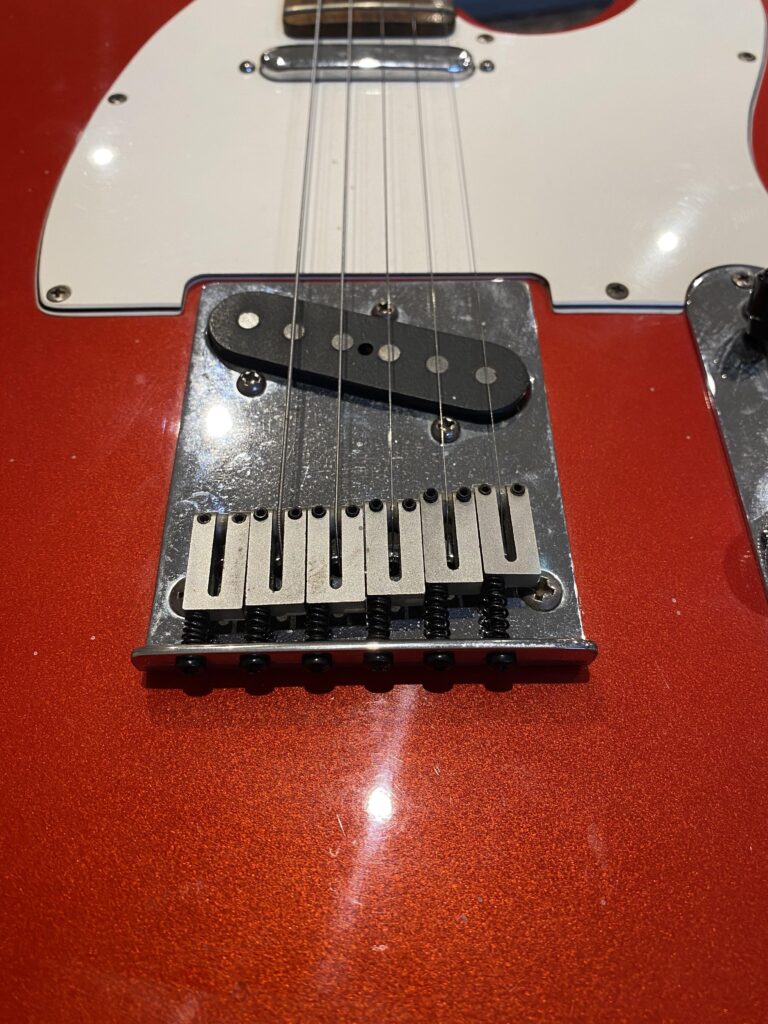
Photo: Getty Images
The original Telecaster plates were stamped from 18-gauge cold-rolled steel. Why does that matter to your ears? Most modern bridges on other guitars are made of zinc, aluminium, or non-magnetic brass. But steel is ferrous, meaning a magnet will stick to it.
When you drop that bridge pickup into a steel bridge plate, something magical happens. The plate isn’t just a holder; it becomes part of the electrical circuit. It acts as a magnetic reflector, redirecting the pickup’s magnetic field back toward the strings.
I’ve experimented with this myself.
If you take a Telecaster bridge pickup and mount it in a plastic ring on a different guitar, it loses its soul. It sounds thin and polite. But when you put it back into that steel plate, it gains that famous “snap” and “cluck.” The bridge plate is like a megaphone for the pickup’s magnetism. It’s the reason why no other guitar can truly mimic the “bite” of a Tele. It’s like the difference between running a race in soft sand versus running on solid concrete. The steel plate is your concrete.
Let’s address the elephant in the room – Intonation.
For those of us who struggle with details, or if you have that ADHD-driven perfectionism, the 3-saddle bridge can feel like a personal attack. How can two strings share one saddle? If the top E string is perfectly in tune at the 12th fret, the B string might be slightly off. It seems mathematically impossible to win.
But here is where the Telecaster becomes a teacher. Back in the 1950s, players didn’t have digital tuners that were accurate to the millisecond. They had their ears.
There is a legendary trick that involves slightly bending the adjustment screws. This “fishtails” the saddle, angling it just enough to get the intonation remarkably close. But more importantly, the 3-saddle bridge forces you to play with touch.
I often think about the great Chet Atkins. He once played these strange South American guitars where the frets were literally placed in the wrong spots by the factory. Did he send them back? No. He adjusted his finger pressure. He learned exactly how hard to press each string to bring it into tune.
The Telecaster is an expressive, living instrument. It’s not a computer. When the intonation isn’t “mathematically perfect,” the guitar creates these beautiful, slightly rubbing harmonics that make a chord sound “bigger” and more “alive.” It has a human quality, slight imperfections that create a character.
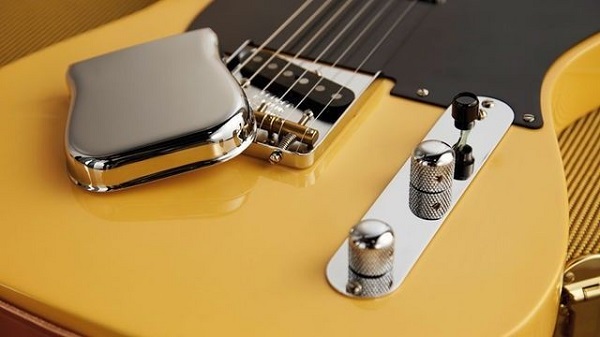
Photo: Getty Images
Comfort vs. Character
From my experience, I can say the “ashtray” bridge isn’t always the most comfortable, but this is just my personal opinion op If you’re used to the smooth, flat surface of a modern bridge, those side walls (the “fences”) of the vintage one can feel like they’re in the way. If your bridge is set up poorly, the height-adjustment screws can stick out like tiny needles, literal “hand-shredders.”
But for me, those walls are home. They provide what I call “sensory grounding.”
When I’m playing a fast country lick or a heavy blues shuffle, my hand knows precisely where it is because it’s resting against that metal wall. It gives me a physical reference point. For those of us who sometimes feel a bit “scattered” in our playing, having that physical feedback actually helps us stay focused. It’s like having a guide rail for your hand.
The modern, flat bridge is like driving a car with an automatic transmission. It’s smooth, efficient, and “easier.” But you lose that raw, mechanical connection to the machine. You lose the “feedback” that tells you exactly where the soul of the guitar is sitting.
The Elevator Plate
Here is a term you can use to impress your gear-head friends at the next jam session: The Elevator Plate.
Mr Fender was a master of simplicity. If you look at the bottom of a traditional Telecaster bridge pickup, you’ll see a plate of metal (usually copper-plated steel) that the pickup is mounted to. Fender called it the “elevator” because it’s what allows you to raise and lower the pickup height using those three mounting screws.
But it does so much more than move the pickup. This plate is the secret partner to the bridge plate. Together, they create a “magnetic sandwich” around your pickup. It grounds the pickup, helping to reduce that 60-cycle hum we all love and hate. It adds more ferrous mass to the magnetic circuit.
I’ve seen people remove these plates because they thought they were “unnecessary weight.” Please don’t do it! That plate is the difference between a guitar that sounds “good” and a guitar that sounds “legendary.” It’s what gives the bridge pickup its “thump” and its “honk.” Without it, you’re just playing a pickup; with it, you’re playing a Telecaster.
Does the Bridge Affect the Tone?
If you’re still wondering if you should swap your bridge, let’s look at the tonal differences through a professional lens:
The Vintage 3-Saddle Bridge: This setup creates a more “microphonic” sound. It’s airy, averaging around 2,000 to 4,000 Hz, giving it an open, spacious sound, and it’s jangly, often described as sparkly, with peaks around 8,000 Hz. It has a complex set of harmonic overtones that contribute to its unique resonance. Because two strings are putting pressure on a single saddle, the downward force is doubled, leading to an increased energy transfer into the bridge plate and the body. This enhanced energy distribution can add a subtle increase in volume and sustain, sometimes boosting overall sound levels by around 2-3 decibels compared to other setups.
Credit: Pints of Guinness
The Modern 6-Saddle Bridge: This usually sounds “stiffer” and more “stable.” It has more sustain in a traditional sense, but it can lose that quirky, bouncy character. It’s cleaner, but sometimes “cleaner” means “less interesting.”
The material of the saddles themselves:
Brass: This is the 50s classic. Brass is a softer metal. It absorbs some of those piercing “ice-pick” highs and adds a warm, vocal mid-range.
Steel: Brighter and more aggressive. If you want that “Bakersfield” sparkle that can cut through a loud drum kit, steel is your friend.
If you’re sitting there with your Telecaster right now, take a second to look at that bridge. Whether it’s a 3-saddle vintage style or a 6-saddle modern one, that plate is the heart of your sound.
If you find yourself struggling with the “rules” of gear, don’t worry. I’ve spent years overthinking this, so you don’t have to. The Telecaster was designed for working people. It was designed to be repaired with a screwdriver and a prayer.
If your bridge feels a bit “clunky” or your intonation isn’t “perfect,” don’t let that stop you from making music. Some of the most outstanding records in history, from Led Zeppelin I, to the best of Buck Owens, were made on guitars that were technically “imperfect.” What mattered was the soul, the grit, and the connection between the player and the metal.
The Telecaster bridge isn’t just a part. It’s a legacy of industrial design. It’s Fender’s radio-shop brilliance, wrapped in 18-gauge steel, waiting for you to plug in and turn up. It’s a mirror of your playing. If you play with tension, it sounds harsh; if you play with heart, it sings.
So, get your Tele out. Look at that plate. Pat it. And then plug in and let that steel talk. It has a lot to say if you’re willing to listen.
Remember
The Plate: It’s made of steel because steel “talks” to the magnets in your pickup.
The “Ashtray”: The high walls give you a place to rest your hand and stay grounded.
Three saddles mean more pressure and more “vibe”; 6 saddles mean more precision.
Brass vs Steel: Brass for warmth and “honk”; Steel for “bite” and “zing.”
The Secret – Your touch and your ear are more critical than any digital tuner.