Before my first electric guitar became basement decor, I was a 17-year-old kid hustling weekend gigs—birthday parties, sing-alongs, whatever paid. My buddy handled keys and jokes; I was the guitarist, cranking out covers for tips and free cake. The money wasn’t bad, but the dream was bigger: I wanted to be the guitarist, the one people came to see.
Then, one day, the radio hit me with a blues riff—raw, unhurried, alive. The guitar wasn’t my cheap classical or the electric I’d begged my parents for. It was something else: a steel-string acoustic, ringing with this honeyed metallic growl. I needed to know: What the hell was that?
This was before Google, so I did things the old-school way: I asked around, visited music stores, and feigned interest in buying just to hear that sound again. Turns out, it was a proper acoustic guitar—steel strings, solid wood, the whole deal. And once I finally got my hands on one? Game over.
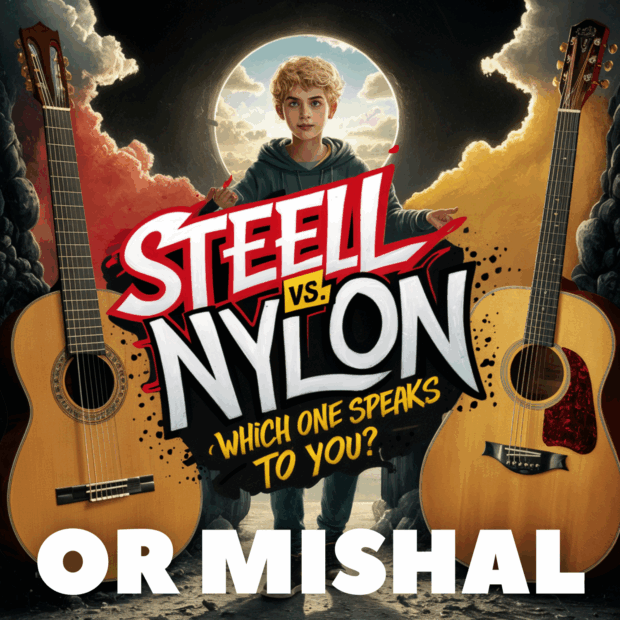
Nylon vs. Steel – The Famous Debate
Choosing between a nylon-string classical and a steel-string acoustic isn’t about one being “better” than the other. It’s about understanding their unique voices, what they bring to the musical table, and ultimately, which one speaks to your soul. Both have shaped countless musical journeys, mine included and continue to inspire generations of guitarists.
Let’s clarify a few things. The classical guitar, with its nylon strings, is often the first choice for aspiring musicians. It’s light, comfortable to hold, and produces an open, airy sound with a surprising depth. It’s incredibly versatile, perfect for classical music, bossa nova, flamenco, jazz, gypsy music, and even simple song accompaniment. For years, I, like many others, thought classical guitars were primarily rhythm instruments, good for strumming chords. But you can play lead on them, though the soloing style is distinct from what you’d typically hear on a steel-string acoustic or an electric guitar.
Check out this fiery flamenco showdown – a live performance of three absolute legends: Paco de Lucía, John McLaughlin, and Al Di Meola. Now, here’s where it gets interesting for gearheads and tone chasers: While Paco and McLaughlin are wielding classical nylon-string beasts, Di Meola (the dude in the middle) is rocking a steel-string acoustic.
Close your eyes and let your ears do the work – that’s the real lesson here. By the end of this, you’ll start catching the difference in other tracks, like a producer with golden ears. Nylon’s got that smooth, liquid heat; steel brings the metallic snarl. Play it loud, and thank me later.
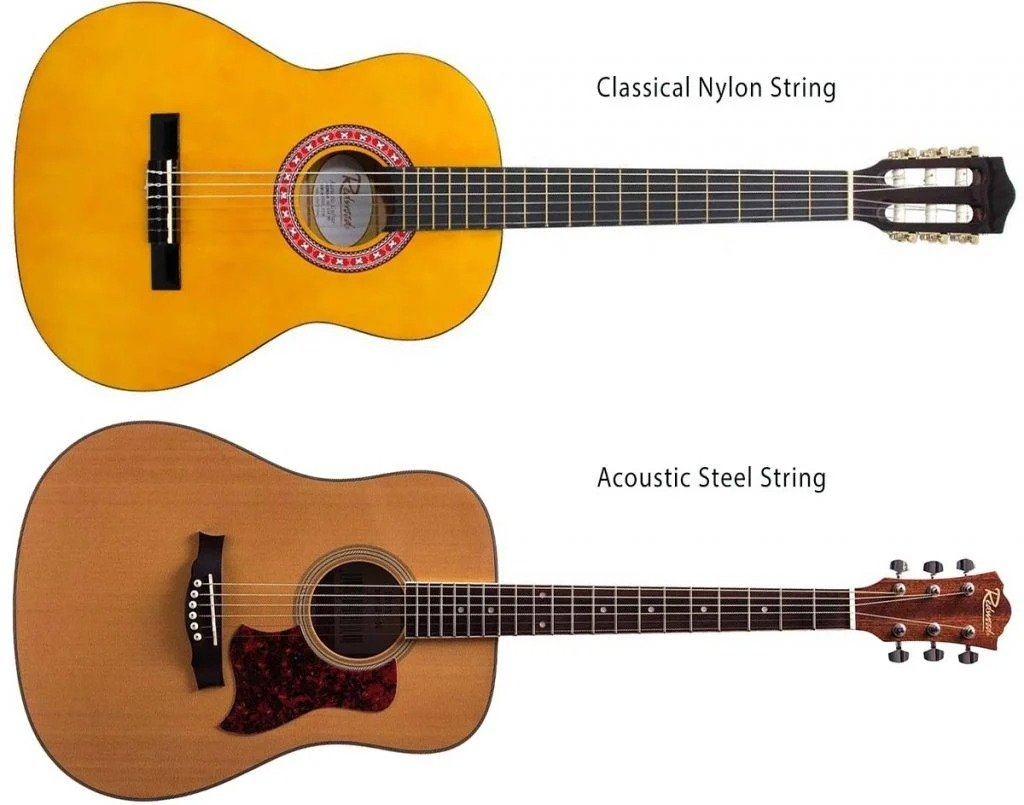
One of the other noticeable differences between a classical and an acoustic guitar is the neck width. If you look closely, you’ll see that electric and acoustic guitars generally have narrower necks, while classical guitars boast wider necks with more widely spaced frets. This design helps beginners properly position their fingers for chords and navigate melodies.
Another key difference lies in the body construction. Classical guitars usually have a smaller, lighter body with a more rounded shape, which contributes to their soft, mellow sound. Steel-string acoustics tend to have larger, more robust bodies, such as dreadnoughts or jumbos, designed to project louder and cut through other instruments, making them ideal for live performances without amplification.
Beyond the strings and body, the bridge design also plays a crucial role. Classical guitars typically feature a tie-block bridge, where the nylon strings are tied directly to the bridge. This design contributes to the instrument’s softer attack and sustain. In contrast, steel-string acoustics often have a pin bridge, where the strings are held in place by bridge pins. This allows for higher string tension, which in turn drives the top more powerfully, contributing to the louder, brighter sound characteristic of steel-string acoustics.
Echoes of the Soul
For a long time, I believed that all unamplified classical guitars sounded remarkably similar, regardless of the manufacturer. However, as I continued my journey, passively listening and comparing, I realized that truly high-quality classical guitars, especially those designed for classical players, possess a natural resonance and profound depth that can be discerned even without amplification. Sometimes, that rich, natural tone can even remind you of an acoustic grand piano.
While traditional classical guitars are often enjoyed for their natural, unamplified resonance in intimate settings, modern classical guitarists frequently use sophisticated pickup systems to amplify their sound for larger venues without losing the instrument’s delicate nuances. Steel-string acoustics, on the other hand, are commonly outfitted with built-in electronics (pickups and preamps) to easily connect to amplifiers or PA systems, making them stage-ready for amplified performances.
The versatility of the classical guitar in the last 50 years has been incredible, spanning everything from the vibrant gypsy music of Gipsy Kings to the intricate Spanish flamenco of masters like Paco de Lucía. It’s also at home in traditional jazz, Brazilian bossa nova, and samba, as well as a wide array of world and Latin music styles. Other notable classical guitarists include Julian Bream, John Williams, and Andrés Segovia, whose contributions have shaped the landscape of classical guitar music.
The Nuanced Art of Classical Guitar – A Genre-Hopping Journey
Before you lie a curated collection of videos showcasing the versatility of classical guitar across genres, from fiery Flamenco to soul-stirring Bossa Nova, the nylon-string guitar proves it’s far more than just an “entry-level” instrument—it’s a world of technique, tradition, and relentless refinement.
The Gypsy Kings: The Rhythmic Soul of Nylon Strings
Their iconic sound is built on classical guitars, used not just for rhythm but for those hypnotic riffs that define their brand of Gitane soul. Their fiery rumba flamenca is driven by nylon-string guitars, where rhythmic strumming meets intricate melodic riffs. Watch how the instrument drives its sound—raw, percussive, and drenched in emotion.
Bossa Nova – Brazil’s Jazz Revolution
A genre that carved its niche in the rich tapestry of jazz and reshaped it for decades to come. Bossa Nova redefined jazz with its whispered vocals and syncopated grooves. Listen closely—every note breathes.
Flamenco & Rumba – Spain’s Burning Heart
And, of course, no discussion of classical guitar is complete without Rumba and Flamenco, the Spanish-born styles that earned the instrument its nickname: the “Spanish guitar.” Whether in instrumental pieces or vocal-driven compositions, the guitar is the heartbeat of these genres, demanding precision, passion, and an almost poetic sense of phrasing.
The Classical Realm – Precision as an Art Form
Classical guitar, especially in the formal repertoire, is unforgiving. There’s no hiding behind distortion or reverb. Every missed note, every unstable pitch is laid bare. That’s why classical guitarists drill for hours, honing their craft with near-surgical precision.
The playing style here is worlds apart from that of steel-string acoustic or electric guitar, not just in technique but in touch, tone, and phrasing – that lush, resonant tone that turns every piece into a masterpiece. And while some dismiss nylon strings as “softer” or “easier,” the reality is far more complex.
But here’s the beauty of it: if you connect with the genre and embrace the challenge, what seems impossible at first becomes an exhilarating conquest. It’s not for everyone—but for those who commit, the reward is a voice unlike any other.
The Steel-String Chronicles – An Acoustic Guitar Odyssey
The steel-string acoustic guitar isn’t just an instrument—it’s a force of nature. That bright, metallic ring, the percussive punch, the way it can go from whisper-quiet to roaring in a single strum? Pure sonic alchemy. While the classical guitar seduces with nylon-string subtlety, the acoustic guitar commands attention. It’s the workhorse of folk, the storyteller of blues, the backbone of country, and the secret weapon of rock.
While classical guitars use nylon, acoustic guitars typically feature bronze and steel strings. Though steel strings might look thinner than nylon, they’re tougher on your fingertips, especially when you’re just starting. I remember those early days, my fingertips toughening up after countless hours of practice.
The steel-string acoustic is the backbone of numerous genres, including country, blues, bluegrass, folk, acoustic rock, and indie acoustic. For many guitarists, this instrument became the very foundation of their careers. Take Tommy Emmanuel and Molly Tuttle in bluegrass – their mastery of the acoustic guitar is legendary. In the blues, while many great blues guitarists are known for their electric work, the realm of acoustic blues is rich in history.
Eric Clapton certainly has his acoustic blues moments, but finding someone whose entire blues foundation is purely acoustic, like Tommy Emmanuel’s bluegrass focus, can be a challenge. That said, blues legends like Robert Johnson, Blind Willie McTell, and Mississippi John Hurt built their careers on the acoustic guitar, creating a raw, authentic sound that defines acoustic blues.
For folk music, artists like Bob Dylan, Joan Baez, and James Taylor are synonymous with the acoustic guitar, using it to craft timeless songs. In the country, think of Johnny Cash and Willie Nelson, whose iconic sounds are deeply intertwined with the acoustic. The list goes on, from the intricate to the mundane.
Bluegrass – Where Fingers Fly at Warp Speed
If speed, precision, and toe-tapping grooves are your thing, bluegrass is your playground. The acoustic guitar here isn’t just accompaniment—it’s a lead instrument, trading licks with banjos and fiddles at breakneck tempos.
Tommy Emmanuel – “Classical Gas” (Acoustic Bluegrass Version)
Watch how his thumb keeps the bassline pumping while his fingers dance across melodies. No picks, no pedals—just raw skill.
Molly Tuttle – “White Freightliner”
A modern bluegrass phenom, Tuttle’s flatpicking is so clean it could cut glass. Notice how every note pops.
Blues – The Raw, Unfiltered Soul of Steel
Acoustic blues is where it all began—no amps, no effects, just wood, wire, and worn-in fingertips. It’s storytelling at its grittiest.
Eric Clapton (Unplugged Era) – “Nobody Knows You When You’re Down and Out”
Even an electric blues god-like Clapton bows to the acoustic’s power. His MTV Unplugged session is a masterclass in feel.
Folk & Country – The Soundtrack of Stories
From protest songs to campfire singalongs, the acoustic guitar carries generations of voices.
Bob Dylan – “Don’t Think Twice, It’s All Right”
Dylan’s fingerpicking here is deceptively simple—but try nailing that conversational rhythm. It’s harder than it sounds.
Indie & Modern Acoustic – Breaking the Rules
Today’s players are pushing boundaries—percussive tapping, alternate tunings, and more.
Ed Sheeran – “Shape of You” (Loop Pedal Live)
Proof that an acoustic guitar can be a one-person band. His right-hand thumps? Pure groove.
John Butler – “Ocean”
It’s a 12-string epic with slides, slaps, and a climax that’ll give you chills.
A few facts in conclusion
Volume – Nylon can’t compete with a dreadnought’s boom.
Attack – Bright, punchy tones cut through a mix.
Versatility – Strum hard for rock, play soft for folk.
Which One Wins?
Neither. That’s the beauty. While classical guitars are often associated with traditional genres, modern musicians are pushing boundaries. Artists like Rodrigo and Gabriela have brought nylon-string guitars into rock and metal-inspired arrangements, using percussive techniques and fast fingerstyle to create high-energy performances. Likewise, steel-string acoustics have adapted into modern pop and even EDM hybrids, showing up in songs by Ed Sheeran or Avicii.
The classical guitar whispers secrets of centuries; the steel string shouts roadhouse blues. My advice? Play both. Let thenylon teach you patience; the steel teaches you grit. And if anyone tells you one is “better,” smile and play them “Asturias” on nylon—then drop the opening riff of “Layla” on steel. Watch their face.
Final Thought
I’ve loved both for 40 years—not in spite of their differences, but because of them. So, if you’re choosing your first guitar? Ask yourself: Do you want to serenade or stomp? Caress or attack? Either way, you’re in legendary company.
What’s your favorite sound?