–

Photo: Or Mishal
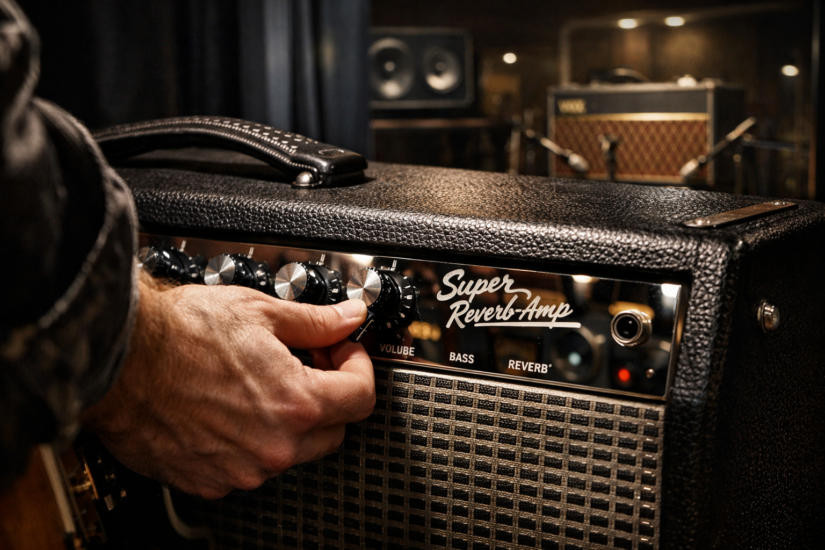
It was a Tuesday in Vancouver, 2021, one of those grey, indecisive afternoons where the sky looks like a wet wool blanket and the air smells like impending rain and old coffee. I was in my studio, surrounded by the usual suspects: a few beat-up cases, a tangle of cables that looked like a nest of black snakes, and my faithful Fender amp sitting in the corner, glowing with that quiet, red authority it’s earned over the decades. Then Rob walked in.
If you don’t know a guy like Rob, you’re missing out on a specific kind of musical heartbreak. He’s a trader, a bottom-feeder in the best sense of the word, a man who can find a diamond in a dumpster and convince you it’s a family heirloom. He was carrying a guitar case that looked like it had survived a house fire, and inside was a Stratocaster copy with no headstock logo. A “no-name” mystery machine he’d picked up for less than 250 bucks.
I looked at the thing and felt that familiar, snobbish itch. The finish was questionable, the hardware looked like it was made of melted-down soda cans, and the strings were probably older than the kid who sold it to him. But then, Rob did the one thing that ends every argument: he plugged it in. He didn’t plug it into a cheap practice amp or a plastic multi-effects pedal; he went straight into my Fender. He hit one E-major chord, and the room didn’t just vibrate, it inhaled.
That $250 piece of firewood sounded like an original 1962 pre-CBS masterpiece. It had that bell-like clarity, that “cluck” in the mids, and a low-end thump that felt like a heartbeat against my ribs. I stared at him, convinced he’d pulled a fast one on me, that he’d hidden a Custom Shop neck under that grime. But Rob just gave me that infuriating, slow-motion smile. “It’s not the wood, Or,” he said. “It’s the box. Your amp is doing all the heavy lifting.”
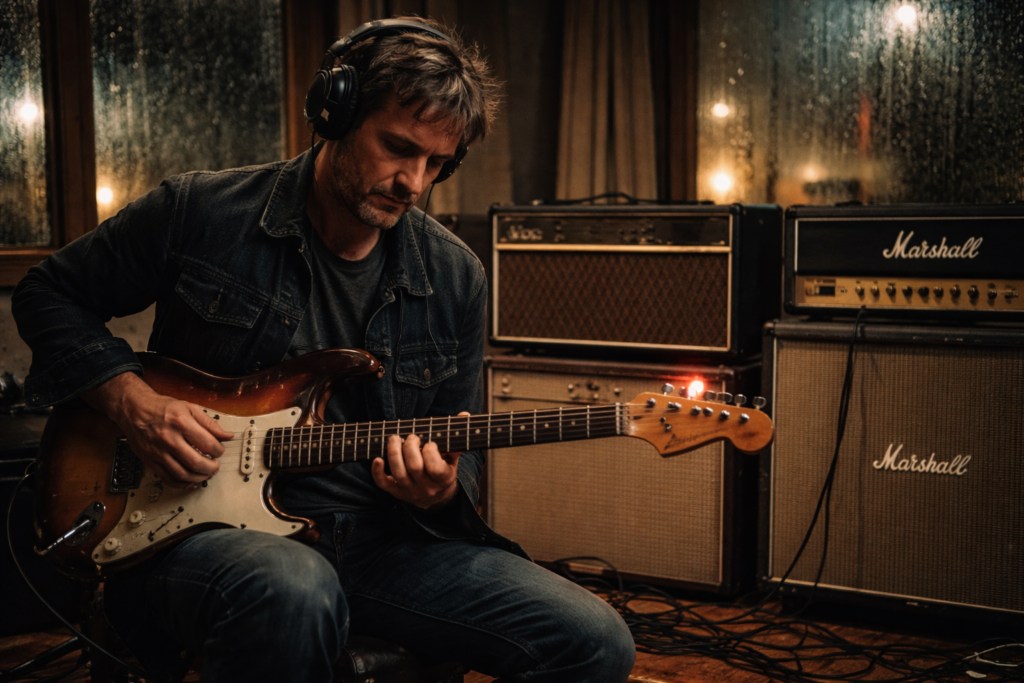
Photo: Indie Studio
This is the hard truth that most gear-heads, including the veterans who spend their nights arguing on forums, hate to admit: The guitar is just the narrator, but the amplifier is the storyteller. You can have the most expensive, hand-carved, “holy grail” guitar in the world, but if you plug it into a box that doesn’t breathe, it’s going to sound like a toy.
Conversely, a great amp, a real, breathing tube beast, or a high-quality vintage transistor can take a budget instrument and give it a soul it never knew it had. For the mothers reading this, struggling to understand why their kid is begging for a “better” setup, or for the beginner staring at a $5,000 price tag with terror, listen closely: your investment shouldn’t start with the wood. It should start with the electricity.
I learned this the hard way back in ’89. My first “real” guitar was a Fender Stratocaster Deluxe, a beautiful instrument that I treated like a religious relic. I paired it with a 100-watt Marshall stack because that was the law of rock and roll back then. It was loud, it was mean, and it smelled like hot dust and rebellion. But as my ears matured and I started drifting into that instrumental space where jazz meets country-fried rock, the Marshall and I stopped speaking the same language.
It was a brawler, and I wanted a poet. I spent years rejecting Fender amps, thinking they were too “clean” or too polite, until the day I finally plugged in and realized that “clean” didn’t mean “weak.” It meant “honest.” That first chord through a Super Reverb was a mirror; it showed me every flaw in my picking, every nuance of my touch, and suddenly, I wasn’t fighting the gear anymore. I was using it to speak.
The Glass Hearts and the Digital Ghost
They run hot enough to fry an egg, they’re fragile as a wine glass, and they’re hilariously inefficient. But here’s the secret that the digital world is still trying to decode: those tubes don’t just amplify a signal. They distort it in a way that sounds like a human voice. They compress the sound, they add “hair” to the notes, and they respond to your fingertips like they’re part of your nervous system.
Let’s talk about the personalities of these glass beasts, because each one tells a different story. The 6L6 is the American giant. It’s the heart of Twin Reverb and the Super Reverb. When you hit a chord through a 6L6, it feels like a wide-open room with no ceiling. It’s warm, it’s deep, and it has this massive, crystalline high-end that doesn’t bite, it shimmers. It’s the sound of Stevie Ray Vaughan’s “Lenny” or John Mayer’s slow-burn blues. It’s honest.
It doesn’t hide your mistakes; it frames them. Then you have the EL34, the British brawler. This is the Marshall sound. If the 6L6 is a warm hug, the EL34 is a firm grip on the shoulder that turns into a shove. It lives in the midrange. It’s aggressive, it’s punchy, and it’s what made Hendrix and Page sound like they were trying to tear the building down. And then there’s the EL84, the small, singing assassin of the Vox AC30. It’s clear, bell-like, and harmonically rich in a way that makes every note feel like it’s vibrating with a secret.
But then, the world changed. Around the turn of the millennium, the “Digital Ghost” arrived. We started seeing these red kidneys called Pods, like the Line 6 HD500, and suddenly, everyone was told they didn’t need the 80-pound wooden boxes anymore. “It’s all in the software,” they said. And look, I’m going to be straight with you, because I’ve been there, in my studio at 1 AM in Vancouver, trying not to wake the neighbors or the police.
Digital modeling is brilliant. It’s consistent, it’s silent, and it’s incredibly practical. If you’re a parent buying a first setup for a kid, or a hobbyist recording in a bedroom, a good plugin or a digital modeler is a godsend. It gives you the sound of a cranked amp without the structural damage to your house.
But here is where the “lie” starts. A digital modeler can give you a perfect snapshot of a sound, but it can’t give you the response. A real tube amp doesn’t just sit there and play back what you give it; it pushes back. When you dig into a real Fender, the amp “sags.” The power transformer struggles for a millisecond, the speakers move air, and you can literally feel the vibration in your pick. It’s a physical conversation between your hands and the electricity.
Credit: Andertons Music Co
Digital modeling is like looking at a high-definition photo of a steak; it looks perfect, but you can’t taste the fat. In a mix, on a record, most people can’t tell the difference anymore. But you can tell. Your hands can tell. And that’s why, even when I’m using the latest software at midnight, I’m always chasing that “missing ghost” that only happens when the glass gets hot.
This brings us to the hybrid reality of the modern studio, the “Magnetic Sandwich” as I like to call it. You see, I don’t have to choose between the vintage soul of my Fenders and the quiet sanity of digital recording anymore. I use a Load Box. Think of it as a mechanical sponge that “soaks up” all the deafening power of my Fender amp and turns it into a whisper-quiet signal for my computer.
The amp thinks it’s screaming at a wall of speakers, so it breathes and saturates exactly like it should, but the actual sound is captured digitally. Then, I apply an IR (Impulse Response), a digital fingerprint of a speaker cabinet. I can make my Fender sound like it’s coming through a massive 4×12 Marshall cab or a tiny 1×12 boutique box with one click. It’s the best of both worlds: the grit of the real tubes and the precision of the digital age.
For the pros out there, this is the secret to getting “that” sound without a $50,000 studio. For the beginners, it’s proof that the path to greatness isn’t a straight line. Whether you’re plugging into a $20 practice amp or a $3,000 vintage head, the goal is the same: find the box that makes you want to keep playing until your fingers bleed. Because at the end of the day, the amp isn’t just gear. It’s the air your music breathes.
The $80 Miracle and the Myth of the Golden Headstock
There is a specific kind of poison in the music world, and it’s called “Gear Envy.” It’s that low-grade fever that tells you your riffs would be better, your tone would be fatter, and your career would finally ignite if only you had that $5,000 Gibson or that boutique amp hand-wired by a hermit in the mountains. We’ve all felt it. We’ve all stared at the “Holy Grail” gear lists of our heroes like they were the keys to a kingdom we’re not allowed to enter. But then, every once in a while, the universe sends you a reality check that hits like a bucket of ice water.
A few months after Rob walked into my studio with that no-name Strat, I stumbled across a video online. It was a kid, maybe nineteen, playing in a room that looked like it hadn’t been painted since the seventies. He had a guitar that probably cost fifty bucks at a garage sale, strings rusted, finish peeling like a bad sunburn. He was plugged into a tiny, ten-watt practice amp, the kind that usually comes in a “starter pack” and ends up as a doorstop. Total investment? Maybe eighty dollars, including the cable.
He started to play. And within ten seconds, nobody in the comments was talking about the gear. The kid was a monster. He had that “touch,” the phrasing, the vibrato, the way he bent a note so it cried exactly the way he wanted it to. He made that cheap, buzzing little box sing like a choir. It was a brutal reminder of the one thing we always try to buy our way out of: The tone lives in the fingers, but the soul lives in the struggle. That kid wasn’t waiting for a “Custom Shop” endorsement to start being a musician. He was making magic with what was within reach.
This is the lesson I want to give to every beginner and every parent reading this: Don’t wait for “perfect” to start being “great.” If you’re a parent, a $20 practice amp isn’t going to ruin your kid’s musical future. In fact, it might save it. There’s a certain grit you develop when you have to fight your gear a little bit. When the amp isn’t doing all the work for you, you learn how to squeeze the tone out of the wood with your own hands. You learn how to compensate, how to listen, and how to find the “sweet spot” in a machine that’s technically imperfect.
Credit: MyDukkan
I’ve seen guys walk into jam sessions or even to rehearsals with professional and expensive equipment that costs more than their car, and they can’t hold a basic rhythm to save their lives. And I’ve seen players like Brent Watson, a guy I played with back in Canada, show up with a white Squier Stratocaster, a “budget” guitar by any definition. To a gear snob, it was a toy. But when Brent started playing, the room went silent. He had a touch that was so delicate, yet so powerful, that the price tag on his headstock became completely irrelevant. He understood that a great translator, the amp, doesn’t change the message; it just clarifies it. But if you have nothing to say, the most expensive translator in the world is just going to amplify your silence.
The industry wants you to believe that you’re “less than” if you don’t have the big-name logo. They want you to stay in that toxic spiral of self-doubt because doubt sells gear. But the truth is, the most legendary records in history weren’t made by people with the biggest bank accounts. They were made by people who grabbed whatever was in the room and mastered it. Jimmy Page recorded Led Zeppelin I on a Telecaster and a small Supro amp that most modern players would dismiss as a practice rig. Kurt Cobain thrived on pawn-shop junk. They didn’t wait for permission. They just did the work.
So, if you’re sitting there wondering if you’re “ready” because you don’t have the “right” gear, stop. You’re ready the moment you decide to be. The amplifier is the story, sure, but you’re the one who has to tell it. Whether you’re plugging into a $3,000 vintage Fender or a $150 Squier through a laptop, the question remains the same: Do you have something worth saying?
The Ghost in the Wire and the Uncomfortable Truth
We’ve talked about the glass tubes, the digital modeling, the $80 miracles, and the weight of a Fender Twin Reverb that can break a man’s spirit and his spine in the same afternoon. We’ve established that the amp is the storyteller, the lung that breathes life into a silent piece of wood. But there’s one more thing, the thing that keeps me up at night after the studio lights are dimmed and the hum of the electricity finally fades into the Vancouver fog.
It’s the question of the “Third Element.”
You see, you can buy the same 1965 Stratocaster that Hendrix played. You can hunt down the exact Marshall Super Lead, the same curly cable, the same worn-out plectrum. You can even recreate the room temperature and the humidity of Electric Lady Studios. You can have the perfect narrator and the perfect storyteller sitting right in front of you. But then you hit a chord… and it sounds like you. Not him. Not a legend. Just you, with all your beautiful, frustrating, human imperfections.
We like to think our “soul” is what travels through the copper wire, into the glowing tubes, and out through the paper cone of the speaker. But have you ever noticed how some days, the gear just… refuses? How one day your Twin Reverb sounds like a living, breathing ocean, and the next day, without you touching a single knob, it sounds like a box of angry bees? We blame the voltage. We blame the strings. We blame the weather.
But maybe, just maybe, the gear is listening back.
The late, great Paco de Lucía once said that the guitar is a “beast” that you have to tame every single day, and that some days, the beast wins. If a master like Paco felt that way about a hollow piece of Spanish cypress, imagine what’s happening inside a complex circuit of capacitors and transformers. There is a ghost in the wire, a variable that no digital algorithm has ever been able to capture, and no boutique builder has ever been able to bottle.

Photo: Indie Studio
It’s the “Uncertainty Principle” of tone.
The next time you’re standing in a music store, staring at a price tag that makes your head spin, or the next time you’re about to delete a “perfect” digital track because it feels “cold,” I want you to ask yourself one question: Are you playing the gear, or is the gear playing you? Is that hum in the background just 60-cycle interference, or is it the sound of the machine waiting for you to say something worth amplifying?
Because here is the final, unsettling truth: The most expensive amp in the world can only give back what you’re brave enough to put into it. And if you’re hiding behind the gear, the gear will eventually find a way to expose you.
The story is waiting. The tubes are getting hot. The narrator is tuned up. But the ending? That hasn’t been written yet. And honestly? I’m not sure any of us truly knows how it’s supposed to sound until the moment it’s over.
So, plug in. Turn up. And for God’s sake, don’t be afraid of the noise. The noise might be the only honest thing you have left.